Technical guide
Fiber-optic static pressure sensors: Fabry-Perot principle, compensation and selection
A static pressure sensor measures a pressure that is stable or changes slowly: the pressure in a chamber, a tank or a gas line. When the measurement point is hot, exposed to strong electromagnetic interference or far from the electronics, electrical sensors reach their limits. This guide explains how a fiber-optic static pressure sensor works, how it corrects for temperature and how to choose one.
- Measurement
- Absolute, gauge or differential
- Range
- Up to 50 bar
- Temperature (standard version)
- 125 °C
- Temperature compensation
- Built-in Bragg grating
What is a static pressure sensor?
Static pressure is the mean pressure of a fluid, stable or slowly varying: the pressure in a tank, a chamber or a pipe. A static pressure sensor measures it continuously, including when it does not change. It differs from a dynamic pressure sensor, which only follows the fast fluctuations around this mean value.
Every pressure measurement is made against a reference: this is what absolute, gauge and differential pressure mean. The Delphinus sensor measures all three: absolute pressure, against a vacuum reference below 10 mbar, gauge pressure and differential pressure.
Absolute, gauge, differential
| Pressure type | Measured against | Examples |
|---|---|---|
| Absolute | vacuum | Vacuum chamber, barometric pressure, altitude |
| Gauge | atmospheric pressure | Hydraulic circuit, tire pressure |
| Differential | a second pressure | Pressure drop across a filter, flow measurement, level in a closed tank |
1 bar = 100 kPa = 1,000 mbar ≈ 14.5 psi. Absolute pressure = gauge pressure + atmospheric pressure (about 1,013 mbar at sea level).
How a fiber-optic Fabry-Perot sensor works
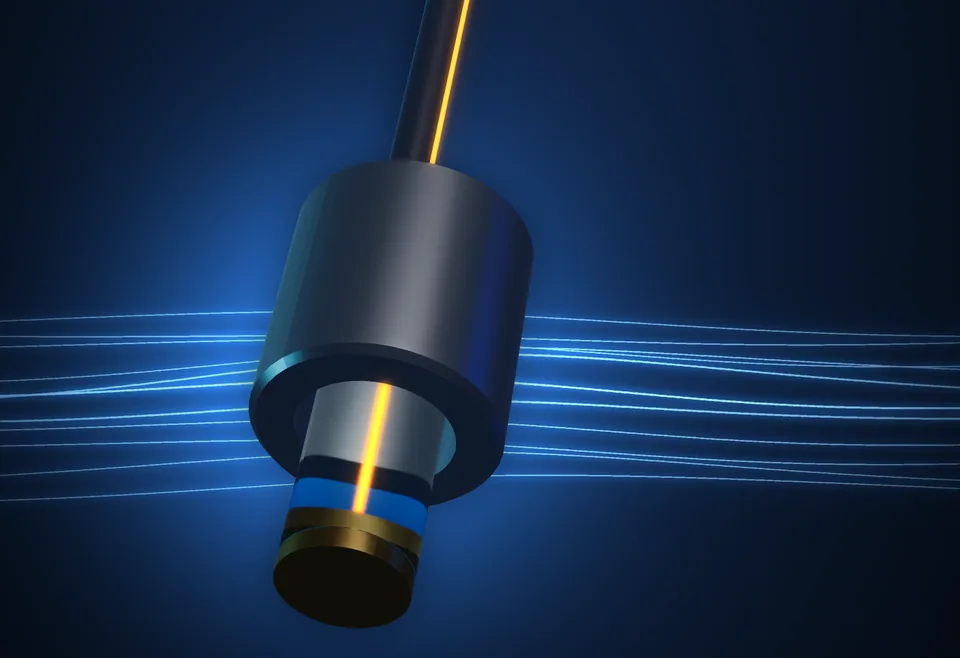
The Delphinus sensor contains no electronics: an optical fiber, a glass ferrule holding it and a silicon diaphragm at its end. The whole measurement is done with light.
- 1
A Fabry-Perot cavity
Light sent into the fiber is reflected by the fiber end and by the diaphragm. The two reflections interfere: the gap between them forms a Fabry-Perot cavity.
- 2
Pressure deflects the diaphragm
The diaphragm bends under pressure and the cavity length changes. In the spectrum of the reflected light, the position and spacing of the interference fringes change with this length.
- 3
The electronics compute the pressure
The electronics developed by Phonoptics analyze this spectrum, derive the cavity length, then the pressure from the sensor calibration.
The measurement relies on the position of the fringes, not on the amount of light received: it is only slightly affected by losses in the optical link, such as a fiber bend or a lower-quality connector.
For an absolute measurement, the other side of the diaphragm faces a vacuum reference (below 10 mbar). For a gauge measurement, it receives atmospheric pressure; for a differential measurement, the second pressure.
Why and how to compensate for temperature
Temperature acts on a pressure sensor even when the pressure does not change. Without correction, it shows up as a false pressure change.
- Materials expand. The fiber, the ferrule and the sensor body expand with heat, which slightly changes the cavity length.
- The diaphragm stiffness changes. The mechanical properties of silicon vary with temperature: for the same pressure, the diaphragm bends slightly differently.
- Trapped gas expands too. If the reference contained gas, its pressure would rise with temperature. A vacuum reference largely removes this effect.
Delphinus includes a fiber Bragg grating (FBG) in the sensor fiber. The grating reflects a precise wavelength that shifts with temperature: it measures the temperature at the same place as the pressure, in the same fiber.
The electronics combine both measurements and correct the pressure for temperature, to keep the measurements accurate over a wide temperature range.
Static pressure sensor technologies
Most static pressure sensors are electrical. They are accurate, proven and affordable; fiber optics take over when the environment makes them struggle.
| Piezoresistive | Capacitive | Fiber-optic Fabry-Perot (Delphinus) | |
|---|---|---|---|
| Principle | Gauges built into a silicon diaphragm change resistance as it bends | The diaphragm is one plate of a capacitor whose capacitance changes with pressure | The diaphragm forms an optical cavity with the fiber end; its length changes with pressure |
| At the measurement point | Electrically powered gauges, often with compensation electronics | Capacitance measurement electronics, close to the sensor | No electronics, only light |
| Temperature | Limited by the silicon gauges and their electronics | Limited by the associated electronics | 125 °C as standard, up to 600 °C under development: the limit comes from the materials |
| Electromagnetic interference | Low-level signal, needs shielding | Sensitive electronics, need protection | Immune |
| Link | Multi-conductor electrical cable | Electrical cable | A single optical fiber, remote electronics |
| Temperature effect | Drift compensated electronically | Drift to be compensated | Measured by a Bragg grating in the same fiber, then corrected |
Piezoresistive and capacitive sensors remain the right choice for most installations. Fiber optics stand out when several constraints add up: heat, strong electromagnetic fields, areas without electrical energy, long distances to the electronics.
The benefits of fiber optics for static pressure
-
Immune to interference
Motors, converters, high voltage: light in the fiber is not affected by electric and magnetic fields.
-
No electrical energy at the measurement point
No possible spark at the sensor: an asset near fuels and in explosive atmospheres.
-
Built-in compensation
The Bragg grating measures temperature in the same fiber as pressure: one fiber, two measurements.
-
A robust measurement
Pressure is derived from the position of the interference fringes, not from the light intensity: link losses have little effect on the measurement.
-
Electronics out of harm's way
The electronics are installed far from the measurement point, in a protected room, connected to the sensor by the fiber.
-
A compact head
The head contains only the fiber, a glass ferrule and the diaphragm: it fits into small spaces.
Connection and mounting
The sensor connects to the fluid like a conventional sensor; only the link changes: a fiber instead of a cable.
-
Screw-in version
The sensor screws into a pressure port, with the diaphragm facing the fluid to be measured.
-
Compact weld-in version
A 4.9 mm diameter body extended by a 2 mm nozzle, to be welded or connected with a hose or a compression fitting.
-
Fiber routing
The fiber leaves the measurement area through a sealed feedthrough, then runs to the electronics. We work with you on its routing and protection.
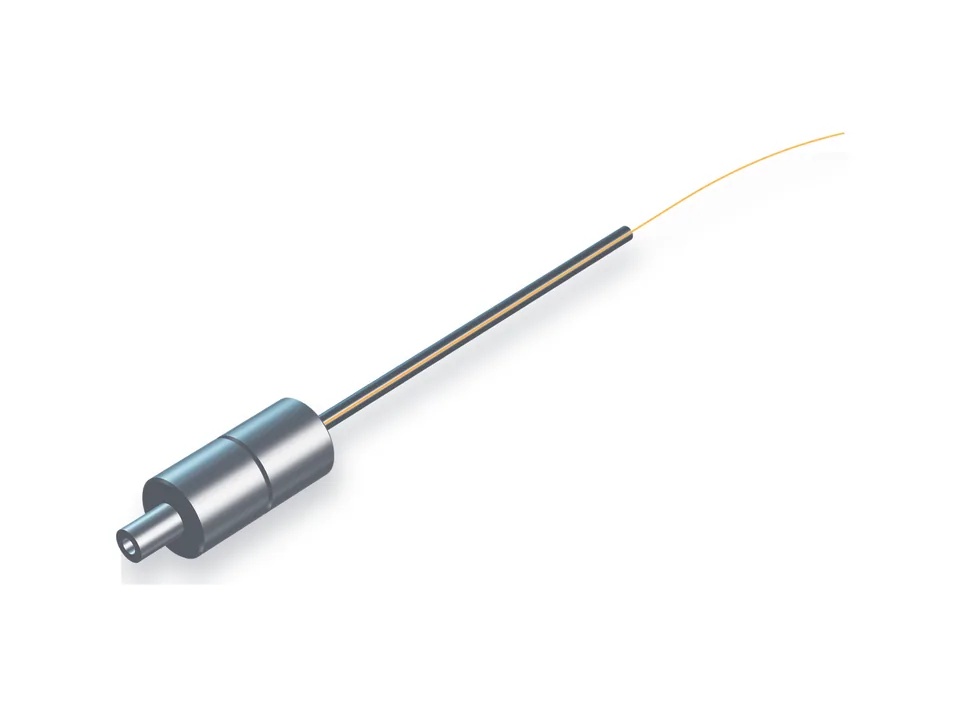
A sensor suited to your installation: as with our other sensors, size, diaphragm and pressure range are adapted on request.
What to know before choosing
- A static or quasi-static measurement. To follow fast fluctuations (pulsations, acoustic waves, shocks), you need a dynamic pressure sensor, such as the Alpheus sensors.
- Dedicated electronics. Delphinus is used with the electronics developed by Phonoptics, which analyze the spectrum of the reflected light and apply the temperature compensation.
- 125 °C for the standard version. Versions up to 600 °C are under development: tell us about your needs.
- The optical link needs care. Clean connectors, fiber bend radius respected, fiber mechanically protected at wall crossings, as in telecommunications.
Applications
-
Test chambers
Absolute pressure measurement inside a test chamber, with no electronics inside.
-
Nuclear
Pressure monitoring in irradiated areas, with the electronics outside the area.
Learn more -
Aerospace test benches
Pressure in circuits and cavities on engine test benches, alongside Alpheus dynamic sensors.
Learn more -
High voltage and strong fields
Measurements near transformers, power converters and magnets, where an electrical sensor picks up too much noise.
-
Explosion hazard areas
Measurements with no electrical energy at the measurement point, near fuels and gases.
-
Long distances
The electronics stay in a protected room, far from the measurement point, connected by the fiber.
How to choose a static pressure sensor?
Five questions to define your sensor:
- 1
Which pressure: absolute, gauge or differential?
Delphinus measures absolute pressure (vacuum reference, below 10 mbar), gauge pressure (against atmospheric pressure) or the differential pressure between two points.
- 2
Which measurement range?
Up to 50 bar. A range close to your actual pressures gives the best resolution.
- 3
Which temperature at the measurement point?
125 °C for the standard version; versions up to 600 °C are under development.
- 4
Which environment?
Electromagnetic interference, radiation, explosive atmosphere, distance to the electronics: all reasons to choose fiber optics.
- 5
Which connection?
Screwed into a pressure port, or the compact version, welded or connected with a hose or a compression fitting. Also plan the fiber routing to the electronics.
The Delphinus static pressure sensor
| Model | Measurement | Range | Temperature | Compensation |
|---|---|---|---|---|
| Delphinus | Absolute (vacuum reference), gauge or differential | Up to 50 bar | 125 °C as standard, up to 600 °C under development | Built-in fiber Bragg grating (FBG) |
Values from the product page. Delphinus is used with the electronics developed by Phonoptics.
The principle on videoCalibration
All our sensors are calibrated in-house. For static pressure, we use a custom-built calibration bench: pressure up to 100 bar, temperature up to 650 °C, with different gases.
Frequently asked questions
What is the difference between absolute, gauge and differential pressure?
Absolute pressure is measured against vacuum, gauge pressure against atmospheric pressure and differential pressure against a second pressure. Absolute pressure = gauge pressure + atmospheric pressure.
What is the difference between a static and a dynamic pressure sensor?
A static sensor measures the pressure itself, including when it does not change. A dynamic sensor only follows the fast fluctuations around the mean pressure, from a few hertz to several hundred kilohertz. Phonoptics offers both: Delphinus for static pressure, Alpheus for dynamic pressure.
What is the Bragg grating in Delphinus for?
It measures the temperature at the same place as the pressure, in the same fiber. The electronics use it to correct the effect of temperature on the pressure measurement.
Does light loss in the fiber distort the measurement?
Only slightly: pressure is derived from the position of the interference fringes in the reflected spectrum, not from the amount of light received. A well-made link still keeps a good signal-to-noise ratio.
Up to what temperature does Delphinus work?
Up to 125 °C for the standard version. Versions up to 600 °C are under development.
Which electronics are needed?
The electronics developed by Phonoptics for Delphinus: they analyze the reflected spectrum, compute the pressure and apply the temperature compensation.
Need to measure static pressure in a harsh environment?
Tell us about your application: pressure type and range, temperature, environment, connection, distance to the electronics. We will help you choose the right configuration.
Read also: High-temperature dynamic pressure sensors · Static pressure: the principle on video · Industries